Taking Care of Your Teeth Naturally by Kirsten Anderberg
Taking Care of Your Teeth Naturally
By Kirsten Anderberg (www.kirstenanderberg.com)
You can now buy my book,
Oral Health, Naturally: Homemade Toothpaste and Mouthwash Recipes for only $2.99!
This book is a culmination of 30 years' research into natural oral health remedies and recipes. Included in this book are instructions to make your own toothbrushes from licorice, marshmallow and alfalfa, and several toothpaste/tooth powder recipes. Also included are a dozen herbal mouthwash recipes, as well as herbal oral remedies, trusted medicinal herb suppliers and links to respected medicinal herb resources. The book centers on herbs that are known to be beneficial to mouths, gums, and teeth, and helps foster a more natural attitude towards dental care and cosmetics, on the whole. The recipes in the book are easy to follow and the ingredients are easily obtained online via the herbal suppliers listed, as well as in local health food and herbal stores.
The following are some excerpts from the book above -
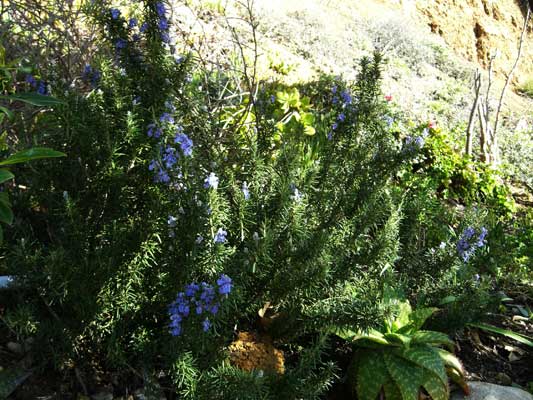
Rosemary in Malibu, CA (Photo: K.Anderberg, 2008)
Try making your own mouthwashes. You can make Rosemary-Mint Mouthwash by boiling 2 1/2 cups water, then take it off the heat and add 1 t. fresh mint leaves, 1 t. rosemary leaves, 1 t. anise seeds, 1 t. tincture of myrrh (optional as preservative). Let the herbs sit in the water for 20 minutes. Cool, strain, then use. You can make a Clove mouthwash by boiling a pint of water with 3 T cloves, bruised or sliced, covered, for an hour. Then cool, strain and use. You can make teas out of any number of herbs, such as rosemary, thyme, lavender, or anise, and use that as an herbal mouthwash as well.
Clove Mouthwash 3 T. cloves (bruised or sliced) ** 1 pint water
Boil water, remove from heat and add bruised cloves. Bruise by pushing on cloves with back of spoon. Cover, let sit for 1 hr. Cool, strain, use.
For your homemade cosmetics needs, I highly recommend Mountain Rose Herbs (click on the banner below)...they sell high quality, fresh, organic herbs...
DISCLAIMER: Do not eat or drink tea from any plant you have not fully studied and identified properly. Please consult with your doctor or local alternative herbal care
specialist before using herbs you are not familiar with.
Kirsten Anderberg. All rights reserved. For permission to reprint/publish, please contact Kirsten at kirstena@resist.ca.





 Kirsten Anderberg. All rights reserved. For permission to reprint/publish, please contact Kirsten at kirstena@resist.ca.