I Wish Everyone Passed The Hat For Their Pay Street performing (or busking) is one of the most radical economic and arts systems I
have seen. It is always walking on outlaw status, it is underground culture (you cannot
get it on TV), and honestly, it takes a very bizarre character to stick to the streets long
enough to become a professional level busker. Certainly there is no viable academic route
to actually working the streets, you cannot learn how to work a crowd via reading or study
alone. One of the most genius buskers I know, Steve Clark, has a song about being a
professional busker. He says, well, if he did not end up making any money from busking, he
at least got to play music all day! Another one of my busking mentors, P.K.Dwyer, one of
Seattle's first street performers, has a song called "Alms," about street performing. It
says, "You say, you can't accept charity, you say, you wouldn't get caught doing that,
But I wish when everybody's day of work was done, we all collected our pay by having to
pass the hat." I am with P.K. on that one. For this article, I interviewed buskers about
their lives, and what makes them do the crazy shit they do.
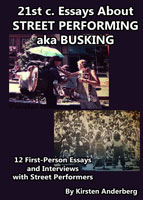
You can order Kirsten's new book about street performing, including interviews with street performers about a wide variety of topics. This is a unique view of the busker world from the inside.
Artis, the Spoonman, used to do a lovely performance piece on why he is a busker. He
recited a long list of good reasons to busk versus playing inside. He listed no age
limits, no minimum drinks, no cover charge, fresh air, etc. He said you get to watch the
show first, then decide what you want to pay for it, a bold move most music venues would
never risk. Andrew Pulkrabek, a 20 year old veteran busker in Seattle, said the reason
he chose the street venue was "the street doesn't hire you, and you don't have to
publicize, or hawk fancy press kits, to market yourself to it. Street performing places
you on a neutral ground where only your show and abilities as a performer count….
Although knowledge of the joy I've brought to my audiences will last long after I stop
busking, local notoriety has been the most immediately appreciable side benefit of being
a young street performer. Nothing impresses a date more than to have a complete stranger
come up to me at a bus stop, and say, "You're the bed of nails guy, right? I love your
show, dude!"
When I look around my house, I see many reminders of my busker past. I walk into my kitchen and there is the hand-carved face on the broom an OCF (Oregon Country Fair) crafter tipped me, and there is the tile of a nun that a fan brought to my show at OCF, on the countertop...I walk into my living room, and I see hanging by my window, the "mosquito house" (a miniature bird house) given to me by a toy vendor at a fair and I see the wind chimes another crafter tipped me. One of the first things that hooked me on street performing was the non-money tips. I remember quite clearly the first time I received a tip in my guitar case of sea shells and trinkets, rather than money. It was like a revelation. The non-money tips followed me throughout my days as a busker. Non-money tips make life exciting and colorful for a busker. For this article, I asked several buskers "What is the coolest tip in your case, that you have ever gotten as a busker?" Read more in my new book, 21st Century Essays on Street Performing aka Busking, on
Kindle!