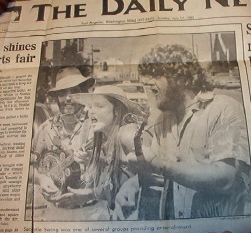
Using Buildings and Awnings as Microphones by Kirsten Anderberg
Using Buildings and Awnings as Microphones
By Kirsten Anderberg (www.kirstenanderberg.com) - July 2006
Kirsten sings with Seattle Swing on the streets...
Acoustic street singing is very different than inside singing, or even singing with amplification via mics. It sounds odd, but I use buildings and awnings as microphones. I have learned over the decades as a street singer, how to aim my voice at different angles off of nearby surfaces and structures to naturally amplify it. Honestly, people who sing on the street but do not have enough projection to be heard are rendered useless pretty fast. I am talking about using structures to fine tune loudness and tone on the street.
I first stumbled upon street acoustics on the Venice Beach Boardwalk in Los Angeles, Ca. The layout has a row of buildings then a walkway, the beach, and the ocean. At first, I saw no difference between singing with my back to the buildings, facing the beach and my audience and singing facing the buildings with the ocean to my back. But in no time, I came to find that singing with the ocean to my back wore out my voice twice as fast as singing with the buildings to my back. I have zero education in acoustics science, I am only reporting what happened. It seems the audience would create a wall and I had the wall behind me, so that worked out. But when I sang with the ocean behind me and the audience and walls in front of me, I only had vocal protection, so to speak, in the front.
That experience in Venice made me aware of structures and using them to save my voice. I began to recognize other patterns too. For instance, when I sing with something *over* me, I can sing longer. If the awning goes out a ways from where I stand against the building wall, I will actually aim my voice into this place at nearly the end of the awning. Most awnings curve at the end, I aim for underneath the center of that curve. It echoes my voice back and helps not only amplify my voice, but also acts like a monitor speaker turned towards performers so they can hear themselves on stage. I can get a better control of my voice using the curved area of awnings.
Today I was throwing my voice around in all directions, just to figure out what the acoustic layout of this new spot I was singing on, was. I actually do sound checks, so to speak, in each spot, to find out what we are dealing with. Today I came to the assessment that I could bounce my voice between the two parallel walls with a small alley between them close to me. This area was to my left, so for quiet subtle stuff, I'd turn my head to the left, towards the wall, for the echo.
But if I knew I was gonna belt something out, I'd turn my head to the right, which had a large open air eating area full of people. The same way I back up from a mic when I know I am about to come to a powerful part of a song, when I am using mics, I was aiming my most powerful vocals to the big open air space to be absorbed there today. It seemed it would echo too loud off the closer parallel walls.
I also noticed if I aimed my voice lower, towards the people eating, sitting at tables today, the voice was pretty well absorbed. But if I aimed the voice up higher, it hit the angle of 2 perpendicular walls of a building behind the open air area, and it echoed back. It did not echo back as loud as the closer walls. Closeness of the walls matters too.
Today I street sang at 5 different locations, all with unique acoustics. The 1st set had no building behind me and no wall in front of me but it had a good awning to aim into. The 2nd set had a building behind me and that parallel and perpendicular wall set up. The 3rd set had a wall behind me, and an awning, but no walls in front of me. The 4th set had a wall behind me but nothing over me, no awning, and no walls in front of me. And the 5th set had a wall behind me, an awning and no walls in front of me.
Those are weird space descriptions, yes. But they each tell a little acoustic story. My set with the most acoustic control today was my 2nd set with all the walls at different angles to echo off of. The 1st and 4th sets were the second easiest to control, as I had walls behind me and awnings. The hardest sets of the day were those without awnings or walls in front of me as was the case with my 3rd and final sets.
You may think that all places to perform on the street are equal, but there are unseen acoustics at play. I find myself bouncing my voice around even for fun as I sing, to find little niches with odd acoustical beauty. Different tones and loudnesses come from walls at different angles and distances...Many a street singer has learned the acoustic layout of the buildings in their town to save their voice. There really is an art form to finding the ultimate angles and acoustics to throw your voice over a large area. Maybe next time you watch a street singer after reading this, you can see the different angles she is playing with and aiming her voice at, for different acoustical effects. Not all street singers are aware of acoustics, using the walls like I do, but many of us are. And it seems the longer you street sing, the clearer these acoustic patterns become.