By Harold Lavender
Whose economic interests are being served by Operation Enduring Freedom? Whose interests are being served by new anti- terrorist legislation such as the just passed US "Patriot Act" and Canada's proposed "anti-terrorist" legislation Bill C-36?
One of the goals of the campaign appears to be to protect economic security. International economic meetings are now going ahead. The World Trade Organization will meet in Qatar from November 9-13. The following week the G-20 (which includes the G-8, the world's most powerful industrialized nations) will be meeting in Ottawa. Officials of the International Monetary Fund (IMF) and World Bank will also be coming to Ottawa for Nov 17.
But is the aim to advance economic security and global justice for the vast majority of the world's population? Or is it to increase the power and profits of global capital and the control of international financial institutions like the World Bank and International Monetary Fund? Is the world being geared up for a new round of trade liberalization and creation of the Free Trade area of the Americas (FTAA)?
Before September 11 there was a rising tide of opposition to this corporate backed neo-liberal economic agenda. Supporters of global justice challenged the model of free trade, deregulation and privatization and social cutbacks and pointed out its costs: growing inequality, deepening poverty for the majority and environmental destruction. Many thousands marched in the streets. The mass revolt in Seattle against the WTO was followed by others against the IMF/World Bank in Washington, against the FTAA in Quebec City, and Genoa.
Heads of state and ministerial officials were forced to meet behind heavily guarded security perimeters or in locations like Qatar (inaccessible to masses of protestors).
Now they want to get back to business as usual, hoping that the post-September 11 climate of mass fear and insecurity and strengthened repressive powers will dampen criticism and shrink or quell protest.
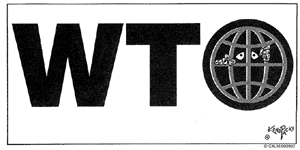
In November 1999 mass protests succeeded in derailing the agenda of the World Trade Organization to initiate a new millennium round of global trade talks. Within the WTO meeting there were intense conflicts between the agendas of the advanced capitalist countries of the North and the countries of the global south. There was also conflicts between the US and European Union over such issues as EU agricultural policies and food security (including EU measures on genetically modified foods).
WTO leader Michael Moore has lamented the lack of progress and time wasted since Seattle. There are desperate efforts to launch a new round of global trade talks at Qatar. The US, Canada and European Union continue to see neo-liberal policies of free trade expansion as the best cure for the woes of economic recession. They want to prioritize agreements on trade in services, investment and competition in a new round. The US and European Union (EU) are trying to set aside differences (including the items on agriculture) at Qatar to create a common front for a new round. Opposition is likely to come from group of 70 poor countries which oppose adding items to the WTO agenda. Already hard hit by existing agreements, they want to secure greater access to Northern markets. And they want to address the great power imbalances between North and South.
The US and its allies are applying intense pressure for a new round. They are using the same carrot and stick tactics as with Operation Enduring Freedom to win support, such as lifting economic sanctions (Pakistan), increased aid, and debt relief. Just hours after receiving a $8 billion debt financing package from the IMF, the Argentine government announced support a new WTO round.
If the US doesn't get what it wants through the WTO, it will seek it through other means such as the FTAA. The US government is putting intense pressure on Latin American nations to agree to the FTAA. But its efforts have been held back by domestic opposition in the US. Fast track legislation is a Bush priority - it would mean congress could only acceptor reject (not amend) an FTAA agreement. US Trade Representative Robert Zoellick has argued that free trade promotes the values at the heart of this protracted war [against international terrorism]. He wants Congress to approve fast track, to send a signal to the world that the US does not plan to retreat from its global responsibilities, including the defense of free trade against terrorist threats and opponents of globalization.
Canada is part and parcel of the global capitalist system. That's why Paul Martin has invited the G-20 and IMF and World Bank to Ottawa.
War and repression is not the answer to terrorism. What about putting human needs first? Every year the number of people in poverty grows, every year more people die from dirty drinking water and lack of affordable drugs. Globally 35,000 people die a day from hunger related causes.
Many of these needs could be met. Measures such as an unconditional cancelation of the third world debt and end to structural adjustment programs (which place the needs of rich creditors first and those of the poor at the bottom of the heap) would be enormously helpful. So would a huge reduction in military spending and curtailment of the international arms trade. Money for genuine international development could be raised by new taxes on speculation, such as the proposed Tobin tax on currency transactions.
Protests may have forced the IMF to change its rhetoric. But its economic prescription remains - despite the fact they have been a colossal failure for the majority. That's why the global justice movement should be visibly protesting in Ottawa.
Without global justice - there can be no global peace. The movement against war needs to take up the need for global justice. And the movement for global justice needs to embrace the movement against war and racism.